
FIFA World Cup 2026™
Group Stages, Matchday 1 Host Cities & Official Radio Broadcasters
| Country | Round 1 Host City | Radio Broadcaster (Rights) | Availability |
|---|---|---|---|
| Group A | |||
| 🇲🇽 Mexico | Mexico City | W Radio / Televisa | Geo-Blocked |
| 🇿🇦 South Africa | Mexico City | SABC Radio | Geo-Blocked |
| 🇰🇷 South Korea | Guadalajara | KBS Radio | Geo-Blocked |
| 🇨🇿 Czech Republic | Guadalajara | Český rozhlas | Global Broadcast |
| Group B | |||
| 🇨🇦 Canada | Toronto | TSN Radio | Geo-Blocked |
| 🇧🇦 Bosnia & Herzegovina | Toronto | BHRT Radio | Geo-Blocked |
| 🇶🇦 Qatar | San Francisco Bay Area | beIN Sports Audio | Geo-Blocked |
| 🇨🇭 Switzerland | San Francisco Bay Area | SRF 3 | Geo-Blocked |
| Group C | |||
| 🇧🇷 Brazil | New York / New Jersey | Rádio Globo | Geo-Blocked |
| 🇲🇦 Morocco | New York / New Jersey | SNRT Radio | Global Broadcast |
| 🇭🇹 Haiti | Boston | Radio Télévision Nationale | Global Broadcast |
| 🏴 Scotland | Boston | BBC Radio Scotland | Geo-Blocked |
| Group D | |||
| 🇺🇸 United States | Los Angeles | Futbol de Primera (ES) | Geo-Blocked |
| 🇵🇾 Paraguay | Los Angeles | Radio Nacional del Paraguay | Global Broadcast |
| 🇦🇺 Australia | Vancouver | SBS Audio | Geo-Blocked |
| 🇹🇷 Türkiye | Vancouver | TRT Radyo 1 | Global Broadcast |
| Group E | |||
| 🇩🇪 Germany | Houston | ARD Audiothek (Sportschau) | Geo-Blocked |
| 🇨🇼 Curaçao | Houston | Radio Hoyer | Global Broadcast |
| 🇨🇮 Ivory Coast | Philadelphia | Radio Côte d’Ivoire | Geo-Blocked |
| 🇪🇨 Ecuador | Philadelphia | Radio La Red | Global Broadcast |
| Group F | |||
| 🇳🇱 Netherlands | Dallas | NPO Radio 1 | Geo-Blocked |
| 🇯🇵 Japan | Dallas | NHK Radio 1 | Geo-Blocked |
| 🇸🇪 Sweden | Monterrey | Sveriges Radio | Geo-Blocked |
| 🇹🇳 Tunisia | Monterrey | Radio Tunisienne | Global Broadcast |
| Group G | |||
| 🇧🇪 Belgium | Seattle | RTBF / VRT | Geo-Blocked |
| 🇪🇬 Egypt | Seattle | ERTU Radio | Geo-Blocked |
| 🇮🇷 Iran | Los Angeles | IRIB Radio Varzesh | Global Broadcast |
| 🇳🇿 New Zealand | Los Angeles | SENZ Radio | Geo-Blocked |
| Group H | |||
| 🇪🇸 Spain | Atlanta | RNE / RTVE Audio | Global Broadcast |
| 🇨🇻 Cape Verde | Atlanta | RTC Radio | Global Broadcast |
| 🇸🇦 Saudi Arabia | Miami | SBC Radio | Geo-Blocked |
| 🇺🇾 Uruguay | Miami | Radio Oriental (CX12) | Global Broadcast |
| Group I | |||
| 🇫🇷 France | New York / New Jersey | RMC Sport | Geo-Blocked |
| 🇸🇳 Senegal | New York / New Jersey | RTS Radio | Global Broadcast |
| 🇮🇶 Iraq | Boston | IMN Radio | Global Broadcast |
| 🇳🇴 Norway | Boston | NRK Radio | Geo-Blocked |
| Group J | |||
| 🇦🇷 Argentina | Kansas City | Radio Nacional | Geo-Blocked |
| 🇩🇿 Algeria | Kansas City | Radio Algérienne | Global Broadcast |
| 🇦🇹 Austria | San Francisco Bay Area | ORF (Ö3) | Geo-Blocked |
| 🇯🇴 Jordan | San Francisco Bay Area | JRTV Radio | Global Broadcast |
| Group K | |||
| 🇵🇹 Portugal | Houston | Antena 1 (RTP) | Global Broadcast |
| 🇨🇩 DR Congo | Houston | RTNC Radio | Global Broadcast |
| 🇺🇿 Uzbekistan | Mexico City | MTRK | Geo-Blocked |
| 🇨🇴 Colombia | Mexico City | Caracol Radio | Global Broadcast |
| Group L | |||
| 🏴 England | Dallas | talkSPORT / BBC Radio 5 Live | Geo-Blocked |
| 🇭🇷 Croatia | Dallas | HRT Radio | Geo-Blocked |
| 🇬🇭 Ghana | Toronto | GBC Radio | Global Broadcast |
| 🇵🇦 Panama | Toronto | RPC Radio | Global Broadcast |
[ai] While high-definition screens and stadium streams dominate the headlines for the FIFA World Cup 2026, the true heartbeat of the tournament’s global reach lies in a much more resilient medium: radio. Across 104 matches, three host nations, and vastly differing time zones, billions of fans won’t be watching the action—they will be feeling it through live audio commentary. From traditional AM/FM terrestrial transmitters piercing through remote terrain to high-fidelity digital web players streaming to smartphones, radio remains the most democratic and immediate way the world consumes the beautiful game.
The Unrivaled Reach of Live Audio Commentary
Radio broadcasting isn’t just a fallback for when a television screen isn’t nearby; it is a specialized art form. Where cameras capture the wide frame, a radio commentator must translate the tactical shifts, the kinetic energy of the crowd, and the precise trajectory of the ball into pure emotion. For millions of commuters, workers, and fans in areas where broadband infrastructure stalls, signal propagation via radio waves is the only thread connecting them to their national team.
As digital audio distribution scales to meet unprecedented demand, broadcasters are balancing classic over-the-air engineering with geo-unlocked streaming players to create a truly borderless stadium experience. Whether it is a local community station or a massive national network, the audio engineers behind the consoles are ensuring that when the first whistle blows in 2026, no one is left in silence.
However, the modern digital broadcasting landscape is heavily guarded by regional rights agreements, making geo-blocking a frustrating reality for the international fan. While massive networks secure lucrative, exclusive rights for their home nations—meaning an official radio stream perfectly clear in London might be blocked if you try to listen in Lima—the fragmentation of media rights has sparked a massive push for broader accessibility. While tech giants like YouTube are bridging the gap by offering global streams of the opening minutes of matches to bypass these digital borders, finding a completely unrestricted, full-match audio stream remains the ultimate prize for the traveling or displaced supporter seeking uninterrupted coverage.
When the live action concludes, the conversation immediately shifts to on-demand audio, cementing 2026 as the biggest World Cup in history for podcasting. Official audio partners, such as talkSPORT with their World Cup Daily and How To Win The World Cup series, are deploying huge rosters of legends and pundits to capture both the tactical nuances and the raw emotion of the North American fan zones. Alongside independent deep dives like The Road to World Cup 26 Podcast, this explosion of audio content serves as the narrative glue between matchdays. These podcasts ensure that long after the stadium lights dim in Mexico City or New York, the stories of the tournament continue to echo in the ears of fans worldwide.
When Teddy Wakelam took his seat in the stands at Highbury in January 1927 to call an Arsenal versus Sheffield United match for the BBC, he effectively birthed the live soccer broadcast. To help audiences visualize the action, a local magazine printed a diagram of the pitch divided into eight numbered zones—a system that famously gave us the phrase “back to square one.” Nearly a century later, as the 2026 World Cup kicks off across North America, the underlying technology has evolved from static-filled AM transmitters to crystal-clear digital streams, yet the core magic remains entirely unchanged. In an era of screen fatigue, complex TV rights, and fragmented streaming subscriptions, radio endures because of its unparalleled intimacy and accessibility. One hundred years on, the theater of the mind is still the greatest stadium in the world, proving that you don’t need to see the ball to feel the absolute thrill of it hitting the back of the net.
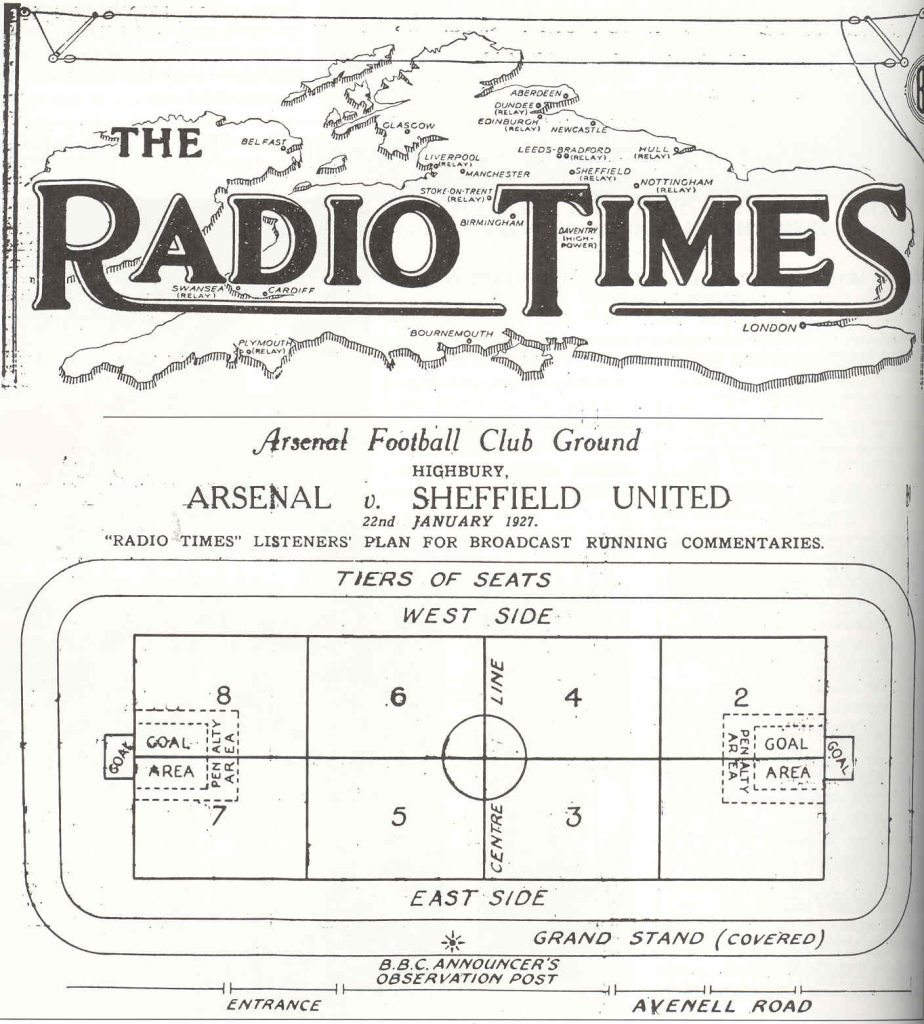
The soccer in 1927 on the BBC wasn’t the first field sport radio broadcast in Europe. The first live commentary on a field sport in Europe was relayed from Croke Park on 29th August 1926. Ireland’s first radio station, 2RN, broadcast the All-Ireland hurling semi-final between Galway and Kilkenny with commentary by Paddy Mehigan.
And for the first world sports broadcast ever we can stay in Dublin. Marconi had been commissioned by the Dublin Daily Express to report the progress of the Kingston Regatta (July 20–22nd July 1898). He did this from a steam tug, sending ‘wireless’ messages back to the harbour where they were subsequently telephoned to Dublin. Becoming the world’s first ‘live’ transmission of a sporting event.