

From Dublin Wit to Somerset Soil: How a Parody Masterpiece Reclaimed the Meaning of a Summer Anthem
Fifty years ago, a brilliant fusion of American folk-pop melody, sharp Irish songwriting, and Somerset ‘Scrumpy and Western’ charm combined to create one of the most enduring novelty hits in broadcasting history. This is the expansive story of “Combine Harvester”—a track that didn’t just conquer the airwaves of June 1976, but traced its creative roots through an Irish chart-topper by Brendan Grace, a clever pen owned by composer Brendan O’Shaughnessy, and the whimsical American foundations laid down by Melanie Safka.
In June 1976, the United Kingdom was in the absolute grip of a historic, record-breaking summer heatwave. As temperatures soared above 30°C day after day, the national airwaves were dominated by an equally surreal cultural phenomenon: a group of Somerset musicians singing in thick, exaggerated West Country accents about agricultural romance. On June 12, 1976, The Wurzels’ “Combine Harvester (Brand New Key)” officially hit Number 1 on the UK Singles Chart, dislodging no less an entry than J.J. Barrie’s “No Charge.”
To the casual listener buying the 7-inch single on the EMI label that summer, it felt like a uniquely English slice of rural comedy. But beneath the tractor grease and hay bales lay a rich, transatlantic lineage that began with a female pop pioneer in the United States and found its comedic voice on the streets of Dublin, Ireland.
The Musical Lineage: Roller Skates to Tractors
The unmistakable melody of “Combine Harvester” was originally written by American singer-songwriter Melanie Safka. In 1971, she released “Brand New Key” (often remembered as “The Roller Skate Song”). Safka’s original track was a whimsical, innocent-sounding folk-pop tune about a girl who had a brand-new pair of roller skates looking for a boy with the corresponding key to lock them. It became a global powerhouse, reaching Number 1 on the US Billboard Hot 100 and charting heavily in the UK and Ireland.
Fast forward to 1975, when talented Irish composer and songwriter Brendan O’Shaughnessy recognized the inherent comedic potential in Safka’s bouncy rhythm. O’Shaughnessy brilliantly flipped the script: he swapped the urban roller skates for a heavy-duty piece of farm machinery and twisted the innocent romantic courtship into an explicitly transaction-focused marriage proposal centered around adjoining farmland.
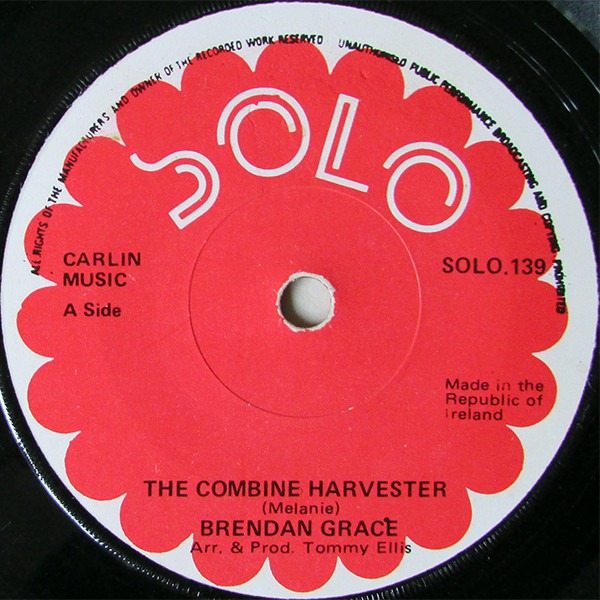
The song was initially given to legendary Irish comedian and singer Brendan Grace. Released in Ireland in late 1975, Grace’s version—fueled by O’Shaughnessy’s witty lyrics—became an absolute runaway success, climbing directly to Number 1 on the Irish Singles Chart. Seeing the phenomenal success across the Irish Sea, the legendary West Country producer Bob Barratt realized the track could be perfectly tailored for a group of Somerset farm-rockers who had been pioneering the “Scrumpy and Western” sub-genre: The Wurzels.
The Anatomy of the Record: Musicians & Credits
When The Wurzels entered the studio to cut their version for the album The Combine Harvester, they leaned heavily into the style established by their late founder, Adge Cutler. The lineup credited on the original 1976 EMI/One Up liner notes featured a tightly knit acoustic ensemble:
- Tommy Banner: Accordion and vocals
- Tony Baylis: Bass, sousaphone, and vocals
- Pete Budd: Banjo, lead vocals, and guitar
Budd’s jaunty, rural delivery of O’Shaughnessy’s lyrics gave the track its definitive UK character. The track takes the core structure of Safka’s original melody but dresses it up with rustic acoustic instrumentation, creating a dense, driving rhythm that felt thoroughly handmade.
Critical Reception & Industry Sales Data
The music press in June 1976 treated the release with the exact mix of bewilderment and begrudging admiration that accompanies all great novelty breakthroughs. NME and Melody Maker journalists, who were concurrently trying to make sense of the burgeoning, aggressive punk rock movement in London’s underground clubs, noted the pure, inescapable escapism of the record. One reviewer famously muttered that the song was “perfectly calibrated to rot the brains of a nation suffering from heatstroke.” Yet, its infectiousness was undeniable.
The British public agreed, buying the physical single in droves.
- Chart Run: After hitting Number 1 on June 12, 1976, it held the top spot for two solid weeks before being replaced by The Real Thing’s “You to Me Are Everything.”
- Sales Certification: The record quickly shifted hundreds of thousands of copies, earning an official Gold Certification from the British Phonographic Industry (BPI)—an immense feat for a comedic parody.
- The Release Timeline: This single served as a crucial transition point. It was preceded by their localized 1975 single “I Am A Cider Drinker” (which would find its own success later in the year as a follow-up) and was succeeded on the release slate by “The Blackbird” later in 1976.
In the Eye of the World: Summer 1976
The sheer absurdity of “Combine Harvester” provided a welcome distraction from a remarkably tense global landscape. While families listened to The Wurzels on their transistor radios, the world around them was experiencing seismic changes:
- The Great Drought: Nationally, the UK was undergoing its driest summer in over two centuries, leading to the appointment of a dedicated “Minister for Drought” and widespread water rationing.
- Global Politics: In June 1976, the Soweto Uprising began in South Africa, marking a tragic and pivotal turning point in the struggle against apartheid.
- Technology & Culture: In the United States, a brand-new electronics company called Apple Computer Company was freshly incorporated by Steve Jobs and Steve Wozniak, quietly laying the groundwork for the modern digital age.
Lyrical Meaning: An Agricultural Pre-Nup
On its surface, “Combine Harvester” is a simple, slapstick song about a farmer attempting to woo a neighbor. However, a closer look at O’Shaughnessy’s lyrics reveals a hilarious, completely unromantic satire of traditional rural marriages of convenience.
Cuz I got a brand new combine harvester
An’ I’ll give you the key
Come on now let’s get together in perfect harmony
I got twenty acres, an’ you got forty-three
Now I got a brand new combine harvester an’ I’ll give you the key
The humor derives entirely from the protagonist’s transparent motives. He isn’t wooing his love interest with poetry or flowers; he is wooing her with heavy machinery and a clear eye on real estate expansion. The fact that she owns “forty-three” acres to his “twenty” makes it abundantly clear who is truly benefiting from this “perfect harmony.” It turns the classic pop love song into an overt, hilarious asset merger.
Desert Island Discs & Retro Accolades
Despite its status as a novelty tune, the track has aged into a beloved pop artifact. While it rarely graces the serious, moody album-oriented “Top 100” lists of high-brow music publications, it consistently finds its place in the Hall of Fame for British comedy records, frequently cited alongside tracks like “Lily the Pink” and “Grandad.”
The track made a high-profile, legendary appearance on BBC Radio 4’s prestigious Desert Island Discs. On November 23, 2007, celebrated British comic actor and writer David Walliams (famed for Little Britain) appeared as the castaway. When tasked with selecting the eight recordings that defined his life and would keep him company in isolation, Walliams proudly selected The Wurzels’ “Combine Harvester,” cementing the song’s status as a foundational piece of eccentric British identity.
The track has seen various archival reissues via EMI’s specialized gold-standard retrospective formats and budget pressings over the years, ensuring that every new generation of cider enthusiasts can access its pristine, analog masters. It remains a joyous monument to a time when music didn’t take itself too seriously, and a rural parody could unite listeners across two islands.
External Archives & Media
To explore the visual design and physical footprint of this summer anthem, visit the verified archives below:
- Take a look at the vintage farmyard imagery on the Discogs.com Entry for The Wurzels’ Combine Harvester.
- Read the comprehensive history of the band’s chart triumphs on the Wikipedia Page for Combine Harvester.
Rediscover the wonderful, sun-drenched nostalgic energy of the track by watching the performance archive on YouTube, or add the beautifully restored version to your playlist directly on Spotify.
Article written with the great assistance of Artificial Intelligence & Human Memory which can contain errors. Errors have been checked but if you spot something wrong contact us.